Meryl SebastianBBC News, Kochi and
Anahita sachdevBBC News, Delhi

 Maddock Films
A new bollywood film has reigned an age-old conversation Around How India’s Larget and Most Influential Film Industry Represents Characters from Non-Hindy Speaking States.
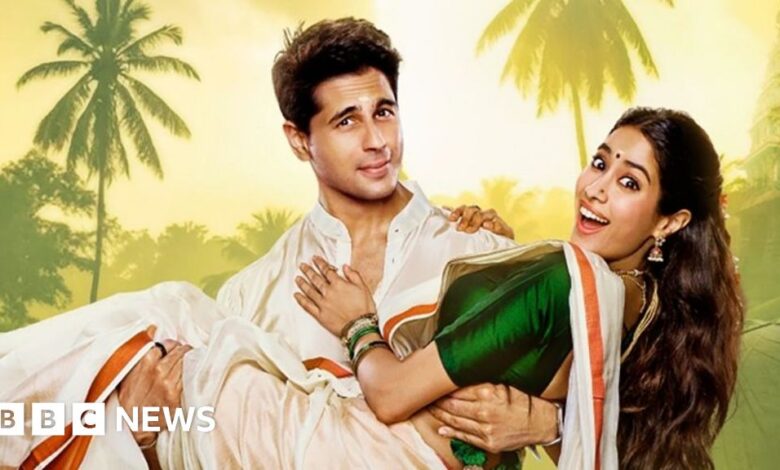
Param Sundari, A Romcom Starring Sidharth Malhotra and Janhvi Kapoor, is a love story between a woman from the southern state of kerala and a man from Delhi in Northern India.
Param and sundari first butt heads and then fall in love, successfully overcoming the Cultural Differences Between them.
The idea isn’t new: bollywood has long explred North-South Cultural Classhes Through Romcoms, and in a Multilingual Country, Well-EXECUTED CROSSS-CROSSS-Cultural Romans Can be a Hit.
But in this case, critics and social media users from kerala and beyond have called out the film for its caricatured depiction of the state, particularly Sundari.
Played by kapoor, Sundari often Wears a String of Jasmine Flowers in her hair, can communicate with elephants and climbs coconut trees as a hobby – all sterepical traits, all sterepical traits, often help Kerala. Thought she’s lived there most of her life, her malayalam is atrocious.
The criticism began as soon as the film’s train trailer was shared, with many puzzling over sundari seemingly mispronouncing Her OWN Name. This is also invited comparison with another Much-Derided Character, Shalini Unnikrishnan (Played By Adah Sharma), from the Controversial Film The kerala story,
 Sunshine Pictures/YouTube
In Both Films, The Heroines, Despite Living In Kerala, Speak Hindi and Are Unable to Speak Fluent Malayalam when they they break into it.
A lesses into param sundari, when param’s friend learns that they will be visited a village in kerala called nangiarkulangara, he exaggeratedly pronounces the names and assks, “where is it?” Combining stereotypes and casual racism into one question.
Once in Kerala, The Film Whizzes Through a Checklist of Things a Layperson Might Associate With The Tourist -Favorite State – its Famous Backwaters, The Ubiquitous Coconut Trees, Toddy, Toddy, Toddy, Elephants, and Onam, Its Most Popular Festival.
One reviewer Called the film “a feature-length ad for kerala tourism” that “that” gleefully bulldozes over all possibilities of any cultural nuance “.
The film brims with coconut gags: param and sundari first met by a tree, she vents her anger by furious harvesting coconuts, and he finally confesses his love from atop one.
For many many viewers, cultural inauguration is not a dealbreaker.
Rajiv, from Northern Bihar State, Saw param sundari as a fun window into an unfamiliar culture, saying its portrayals may not be true to life but life but chasing authenticity can dull entertainment.
“Maybe this will change gradually. But this much artistic freedom is okay to make the movie interesting,” He said.
For others, however, the film’s attempt to educate audiences is half-harted.
In a blistering review, Critic SWMYA Rajendran Slammed The Film as “General, Exhausting and Offensive,” Saying it hides tired clicks behind an “exotic” kerala setting and a score “Foreignness.”
 AFP Via Getty Images
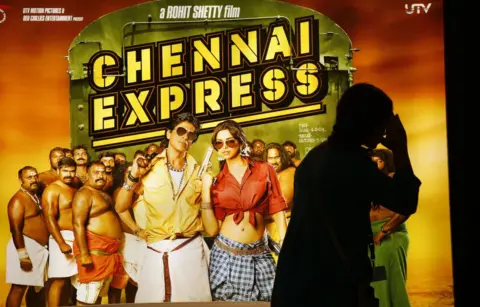
Films often face and survive casting criticisms: Chennai Express (2013) was panned by critics but sored at the box office.
When the makers of Mary Kom (2014) Cast Priyanka Chopra to Play of the Role of the Olympic Medal-Winning Boxer from Manipur State, it was met with plenty of criticism. Chopra herself admitted later that “in Hindsight, the part should have gone to someone from the northeast”. But the film was a hit and chopra won awards for her spirited performance.
And Mehmood’s 1968 Padosan Caricature of a Tamil Singer Remains A Classic.
But the landscape of Indian Entertainment has shifted: Post-Pandemic Cinema Closures and the Rise of Streaming Have Left BollyWood Struggling for Hits, with Big-BUDGET FLOPS SHAKING DOMINANC
Non-Hindi Films Now Reach Nationwide Audiences Via Netflix and Amazon Prime Video, Earning Fans Through Dubbed Versions, While Big Bollywood Releases NO Longer Dominate Cinema PRINEGER DOMINATE CINEGER DOMINATE CE
Since it release, param sundari has earned steadily but slowly, while the malayalam female-superhero film lokah has become a superhit with praise for it praise for it.
In her Article on Param SundariWriter Cris Notes How many Indian Film Industries Accept Actors Playing Roles Outside Their Own Cultures.
“It is when the character look like caricatures of a state or its people that the audience takes offense,” She writes.
Param sundari does try to balance its storytelling. More than once, sundari gets to school param and his friend about their assumptions about her state – in one instance, throwing bias back at them about “ignorant, ignorant, arrogant, arrow Indians.
 Courtesy Cannes Film Festival
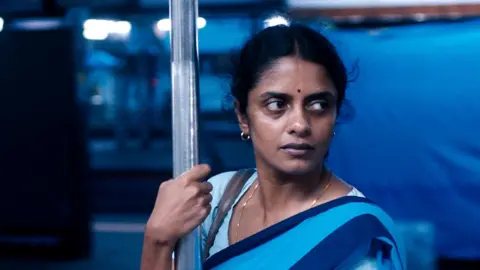
Commentators point to strong examples in India’s Mobile Society: Godha (2017) skilfully tells a cross-class-total romance of a Punjabi wrestler in kerala; Axone (2019) Tackles Discrimination Faced by People from North-Eastern India with WIT; Qarib Qarib Single (2017) Follows a Malayali Woman in Mumbai; And cannes winner all we imagine as light (2024) portrays immigrant struggles with nuance.
Bollywood isn’t alone: Writer and Poet Aleena Notes Malayalam Cinema has stereotyped tribespeeple, dalits (formerly untouchables), and tamil challers, tamil hindi speakers are often caricated in south Films.
“I think this is a larger question of power dynamics and representation,” Aleena says, Emphaising a Community’s Role in Shaping its own stories.
She says that when a story portrays a Community without including the real Voice of people from the communication, its risks are decided skewed and imbalanced.
“We need to make people participants or stakeholders in the art we are trying to make.”
Follow BBC News India on Instagram, YouTube, Twitter and Facebook,